

Industry
Education
Summary
How Haileybury College standardised AV across its CBD campus using Epson ultra short-throw projectors - cutting variation and simplifying support across 600+ teaching spaces.
Integrator
Macmor Electrical Contractors
Brand
Epson

Haileybury College
Since 1892, when their doors first opened with five staff and 17 students in attendance, Haileybury has been a centre of continual development: learning, teaching and location have all undergone transformative change on the path to becoming the school they are today.
Originally published in AV.technology.
With the growth in inner city living comes the need for inner city education. Upwardly mobile urban couples embracing a downtown Melbourne lifestyle now have a blue-ribbon downtown private education provider.
Back in 2013 Haileybury College purchased a hi-rise city building opposite Flagstaff Gardens in the Melbourne CBD. The aim: to provide a primo education option, pre-school to Year 12, for inner-city dwellers and international students.
Haileybury didn’t invent the wheel. Other providers have tried and mostly have lost their shirts on a CBD experiment. Haileybury was taking a calculated risk that it could succeed where others had failed.
In 2014 Haileybury established an early learning centre on the ground floor. This was followed by junior school spaces ready for the 2016 academic year. In 2016, three levels of middle school classes came together along with the boardroom level on the top floor.
Tech Prognostication
It’s not every day that a big school embarks on such a large project involving so much AV and IT. As manager of all of Haileybury’s AV and IT, Dale Eaton rode shotgun from the get-go. It was clear he was looking to standardise his equipment spec and have a sense of what tech a classroom would include for the next five years or more.
“It was about minimising variation,” Dale summarises. “We standardised a lot of the AV kit in the rooms to make it easier.”
Every AV manager’s crystal ball is a bit cloudy on slow-burn jobs such as this — predicting the future tech of a classroom is especially difficult and it’s hard to resist the allure of the bleeding edge.
Dale Eaton: When I started five years ago we had a problem with ‘the next shiny new thing’ regularly finding their way into our classrooms. It created so much variation and became a support nightmare. Variation is a tech staff’s main enemy, especially when staff need to be IT and AV skilled. It’s really rare to find someone that’s actually good in both areas.
Across the four campuses we have more than 600 teaching spaces to look after. So when they were all so varied, it was a serious problem.
We’re now working towards standardising each campus as we go through an annual rolling refresh program.
Three-Year Projections
Projection or LCD screen? What was to be the principal classroom presentation tech? It occupied the brains of Dale Eaton and his team more than most decisions in the lead up to the CBD fitout.
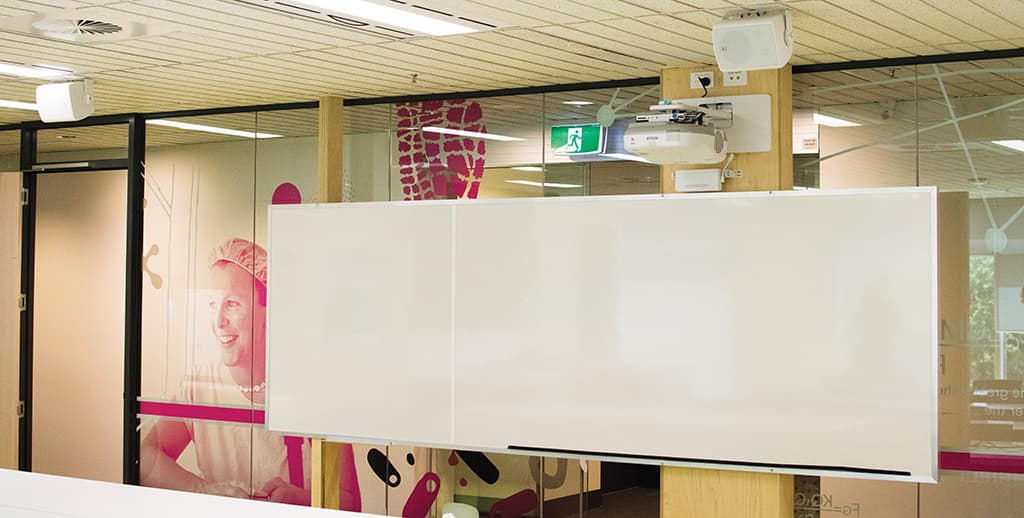
Dale Eaton: In discussions three years ago there was a lot of talk about putting panels up everywhere. They were almost at a stage where they were cost-effective to consider. During our research, we discovered that Epson was bringing out the EB595Wi ultra short-throw, which gave us the interactivity we were after. We felt that was the right combination – mature, proven technology, in the Epson projection, and the very latest interactivity.
We’ve immediately seen the benefits in classes, such as those in the music department — writing musical notes on the board, then routing it straight back to the computer to be saved. Two students writing notes either side of the board… From there the teacher can pop the next lesson up on the board and they’re building a valuable stockpile of materials and resources as they go.
The Epson 595 projectors has taken us way beyond simply projecting onto a screen. The students coming through from junior school are accustomed to interactivity, and that interactivity brings educational advantages.
AV Asia Pacific: How important is it to the school to be perceived as a technological innovator?
Dale Eaton: It’s one of the main goals of the school. We want to be on the cutting edge of technology but we’re also happy to take our turn – we have no desire to be on the bleeding edge — it’s worth learning from other people’s mistakes and successes, and roll that into something we can develop and deploy ourselves.
We’re constantly appraising new product, the fully-interactive touch panels, presentation recording products and the like. But testing and appraising is different to installing into a classroom.
Teachers are not tied to the one classroom above the junior school level. They might be in six different classes throughout the day. If you’ve got six different technical room it’s slowing the teacher down. That’s not a good outcome for the school.
Cookie Cutting Edge
Now that the classroom AV spec has been agreed on, adding classrooms is administratively a smooth process as well as taking the headache out of the design process.
Steff Longmuir: In terms of rolling the project out, the spec is already done. We just have to ‘rinse and repeat’, so it makes it really easy for me as an integrator, while the end result is predictable for Dale and the teachers.
AV Asia Pacific: Predictability and dependability is a positive thing, in this case, and keeps the costs down as well, I imagine.
Dale Eaton: It’s a case of: here’s a new room, raise a purchase order and say ‘go make it look the rest of them’. It’s all about removing variation. It really is.